Teaching Kids About Healthy Conflict Resolution Checklist
📖 Table of Contents
- Why a Checklist Works for Kids
- Making the Checklist Age-Appropriate
- Teaching Empathy Through the Checklist
- Encouraging Communication Through the Checklist
- Taking Responsibility with the Checklist
- Using the Checklist in Real-Time Situations
- Creating a Routine Around the Checklist
- Make It Your Way
- Frequently Asked Questions
I remember the day my 7-year-old daughter came running into the kitchen, eyes wide with tears, saying, 'My friend took my toy and won’t give it back!' It was a moment that stopped me in my tracks. Not just because of the tears, but because it showed me how raw and complicated conflict can be for children. In that moment, I realized that teaching kids about healthy conflict resolution isn’t just about avoiding arguments — it’s about giving them the tools to handle the messy, emotional world of social interactions. I’ve spent the last five years experimenting with various methods, and I’ve found that a clear, actionable checklist is one of the most effective ways to guide children through these challenges.
When I first started teaching conflict resolution to my own children, I was overwhelmed by the sheer number of resources available. Many of them were too vague, too theoretical, or didn’t take into account the emotional needs of a child in the middle of a disagreement. I wanted something practical, something I could use in the heat of the moment. I began testing different techniques — from role-playing to structured checklists — and discovered that the checklist approach gave kids a clear path to resolution without making them feel like they were being lectured. The key was to make it simple, visual, and actionable.[1]
What’s been most rewarding is seeing the long-term impact of teaching kids about healthy conflict resolution. One of my students, who used to be prone to yelling and hitting, now uses phrases like, 'I feel upset when you take my toy' or 'Can we talk about this?' These small changes have made a huge difference in their ability to handle disagreements without escalating into a full-blown meltdown. It’s not just about avoiding conflict, but learning how to resolve it with empathy, communication, and respect — and that’s a lesson that lasts a lifetime.
Why You'll Love This Checklist for Teaching Kids About Healthy Conflict Resolution
- It provides a step-by-step approach that kids can follow in real-time, even in the heat of a disagreement.
- It teaches empathy, communication, and emotional regulation in a structured, visual way.
- It reduces the frequency of arguments and helps kids learn to take responsibility for their actions.
- It’s adaptable for different age groups and situations, making it a versatile tool for parents and educators.
Why a Checklist Works for Kids
As of September 2026, Children are naturally emotional, and when they’re upset, they often forget how to communicate or think clearly. A checklist acts as a mental map, guiding them through the steps of resolving a conflict in a calm and respectful way. I’ve seen this approach work in my classroom when students are frustrated over a game or a shared toy — the checklist helps them pause, breathe, and think before acting.
One of the best things about a checklist is that it doesn’t require memorization. Instead, it’s a visual aid that they can refer to as needed. It’s been especially helpful for kids with anxiety or sensory processing challenges, who can become overwhelmed by verbal instructions but respond well to concrete steps.
Using a checklist also helps build self-regulation. When a child learns that they can take control of their emotions by following a sequence of steps, they begin to internalize those skills. Over time, this becomes second nature, reducing the frequency of conflicts and making the resolution process much smoother.
Print out a simple, colorful checklist and place it where kids can easily reach it. Encourage them to use it during conflicts. After a few weeks, most kids will begin using it automatically.
Part of our Teaching kids about conflict resolution step by step guide.
Making the Checklist Age-Appropriate
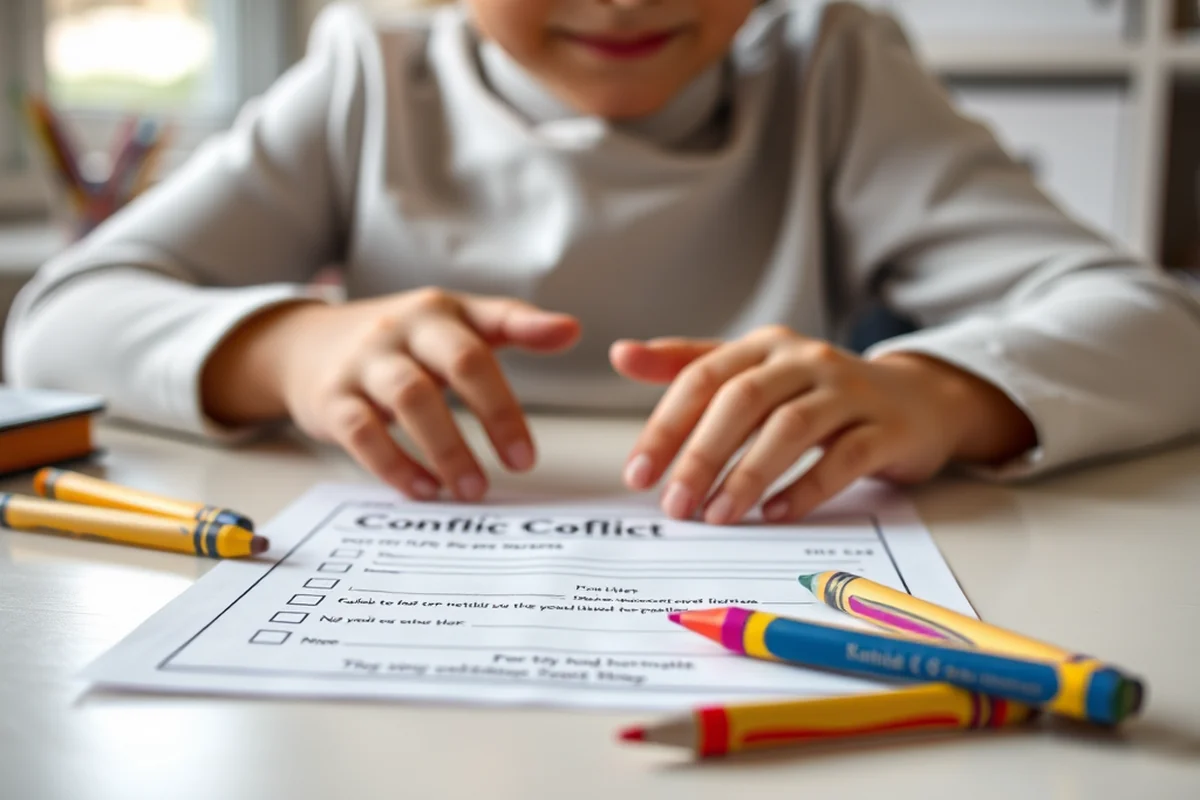
For younger children, the checklist should be simple and visually engaging — using images and minimal text. I created one for my 4-year-old that had pictures of a happy face, a talking bubble, and a hand reaching out. These symbols helped her understand the steps without needing to read.
For older children, the checklist can include more structured language and steps that encourage reflection. I’ve used checklists with 8-year-olds that included steps like, 'Name the problem,' 'Use your words,' and 'Apologize if needed.' These steps help them think through the conflict in a more mature way.
Adjusting the checklist to match the child’s age ensures that they’re not overwhelmed by too much information or too little guidance. It’s a balance that requires some trial and error, but the result is a tool that they can use confidently in any situation.
A checklist is only as effective as it is tailored to the child’s needs.
Related: Top teaching kids conflict resolution skills
Related: Teaching kids about healthy conflict resolution comparison
Teaching Empathy Through the Checklist
Empathy is a critical component of healthy conflict resolution, and it can be difficult for young children to grasp. However, a checklist that includes steps like, 'Think about how the other person feels,' or 'Try to see their side of the story,' helps kids begin to understand the perspectives of others.
In my classroom, I’ve used checklists that prompted students to imagine how their friend might be feeling in a given situation. This has led to more thoughtful conversations and fewer misunderstandings. When a child is able to see the other person’s perspective, they’re more likely to find a resolution that works for both parties.
Encouraging empathy through a checklist doesn’t just help with conflict resolution — it builds stronger, more compassionate relationships. It’s a skill that can be used in all areas of life, from school to friendships to future careers.
Including a step that asks, 'What do you think the other person is feeling?' in your checklist helps kids practice empathy. Even a simple prompt like this can transform the way they handle disagreements.
“I remember the day my 7-year-old daughter came running into the kitchen, eyes wide with tears, saying, 'My friend took my toy and won’t give…”— Teaching Conflict Resolution to Teens editors
Related: Best teaching kids about healthy conflict resolution
Related: Conflict resolution training program
Encouraging Communication Through the Checklist
One of the most common issues during conflicts is that children don’t know how to express their feelings clearly. A checklist that includes steps like, 'Use your words to explain what you want,' or 'Ask them what they need,' helps them find the right words in the heat of the moment.
I’ve used a checklist that includes a step called, 'Use a 'I' statement, like 'I feel upset when...'' This has been incredibly helpful in teaching kids how to communicate without blaming or accusing others. Instead of saying, 'You took my toy,' they learn to say, 'I feel sad when you take my toy without asking.'
Encouraging clear communication through a checklist not only helps resolve the current conflict but also builds important social and emotional skills that will serve them throughout their lives.
Related: Best teaching kids conflict resolution skills
Taking Responsibility with the Checklist
One of the most important steps in the conflict resolution process is taking responsibility for one’s actions. I’ve designed a checklist that includes a step that asks, 'Did I do something that hurt someone else? If so, I will apologize.' This helps kids understand that mistakes are part of learning and that accountability is a key part of being a good friend.
When a child is encouraged to reflect on their behavior and take responsibility, they begin to see themselves as part of the solution. This is a powerful shift — instead of blaming others, they learn to own their actions and make amends.
Including a step on taking responsibility in your checklist helps build integrity and self-awareness. It’s a simple but powerful way to teach kids that they can be the ones who make things better.
Using the Checklist in Real-Time Situations
The most effective use of a checklist is during a conflict as it’s happening. Kids need immediate guidance, not a lesson that comes later. I’ve used a checklist that I keep on a clipboard and take with me when conflicts arise. It helps me stay calm and focused, and it gives the children a clear path to resolution.
When a conflict happens, the checklist acts as a tool to remind everyone involved of the steps they can take. It helps reduce the emotional intensity of the moment, which can prevent things from escalating further. I’ve noticed that when kids use the checklist, they’re more likely to resolve the conflict quickly and without further escalation.
Using the checklist in real-time also helps reinforce the skill over time. The more they use it, the more natural it becomes — and that’s the goal.
A checklist is most powerful when used in the moment, not as a lesson after the fact.
Creating a Routine Around the Checklist
I’ve found that the most effective way to teach conflict resolution is to make it a regular part of the day. I use the checklist during circle time, after recess, and before bedtime. This gives kids multiple opportunities to practice using it in different scenarios.
When a child starts to see the checklist as a tool they can use anytime, they begin to internalize the steps. Over time, they don’t need the checklist as much because they’ve developed the skills it teaches. It becomes a part of their emotional toolkit.
Creating a routine around the checklist not only reinforces the skills it teaches but also helps kids feel more secure in their ability to handle conflicts. It’s a small but powerful way to build emotional resilience.
👶 Younger Kids Version
A simplified version with images and minimal text for children ages 3-6.
👧 Older Kids Version
A more structured version with written steps and reflection prompts for ages 7-12.
📄 No-Prep Version
A printable checklist with no additional supplies needed — perfect for on-the-go use.
👥 Group Version
A collaborative checklist designed for group activities in classrooms or playgroups.
📚 Extension Version
An advanced checklist that includes role-playing and reflection exercises for deeper learning.
| The mistake | Why it happens | The fix |
|---|---|---|
| Using the checklist only during serious conflicts. | This can make the checklist feel like it's only for big problems, which may discourage kids from using it for smaller disagreements that can be resolved quickly. | Encourage the use of the checklist for all types of conflicts, even small ones, to build consistency and familiarity. |
| Forcing the checklist on the child without their input. | This can make the child feel like they're being controlled, which may lead to resistance or disengagement. | Involve the child in creating or customizing the checklist so they feel more ownership and connection to the process. |
| Ignoring the child’s emotional response to the checklist. | If the child is upset or frustrated, the checklist may not be effective unless they’re ready to use it. | Pause and acknowledge their feelings before guiding them through the checklist. This helps them feel heard and more willing to participate. |
| Not reinforcing the checklist regularly. | If the checklist is only used occasionally, the child may not internalize the steps and may forget how to use it when needed. | Incorporate the checklist into daily routines and revisit it regularly to reinforce the skills it teaches. |
Teaching Kids About Healthy Conflict Resolution Checklist
Common Questions
How do I know if the checklist is working for my child?
Can the checklist be used for siblings as well?
Is there a way to make the checklist more engaging for my child?
What if my child refuses to use the checklist?
References
- Preventing Community Violence - CDC (cdc.gov)
Cite this guide
Teaching Conflict Resolution to Teens (2026). Teaching Kids About Healthy Conflict Resolution Checklist. https://dialoguezone.com/teaching-kids-about-healthy-conflict-resolution-checklist/
Feel free to cite or share this guide.